

“It’s not about left vs right, it’s about ___” gets thrown around a lot in US politics, to our detriment. It is an incorrect statement that only makes things harder to understand. Take a recent analysis from longtime Intercept DC Bureau Chief and Drop Site co-founder Ryan Grim on Zohran Mamdani’s meeting with Donald Trump:
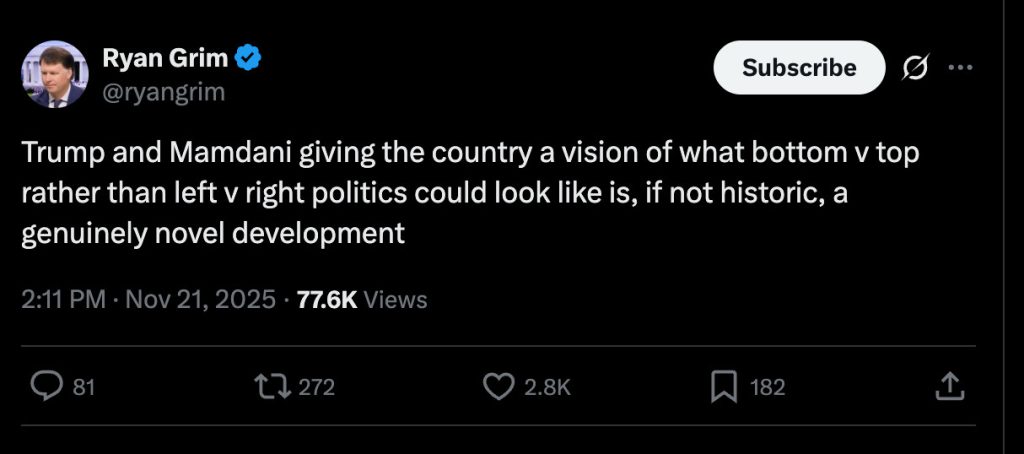
As Jamelle Bouie put it: “‘politics is bottom/top not left/right’ might work as a slogan but is shit as analysis. who is the bottom? who is the top? who constitutes an ‘elite’ and who belongs to ‘the people?’ these are important questions that have to be answered.”
And once you do answer these questions, you land back at the truth: politics is about left vs right. Always. Because these words describe political directions, and there’s only two. While particular policy positions may change, the fundamental principles of what they are trying to achieve do not. As Corey Robin’s book The Reactionary Mind finds through tracing centuries of conservative thought, the right wing’s immutable core principle is the preservation of a hierarchy of domination, by the few over the many. And this right wing emerges in reaction to the left, whose principles demand an equalizing redistribution of power from the few to the many.
Like what you’re reading? Support our work by joining our Patreon for free or as a subscriber!
Knowing this history is especially helpful in understanding how the MAGA movement’s breaks with past Republican policy are not part of some novel new post-right politics, but merely the latest iteration of a tactic as old as the right. It is not new for the right to adopt changes that may, at first glance, appear to move against existing hierarchy the way the left does. But look closer, and they are only ever in service of updating tactics to preserve that hierarchy. For example, the right wing may expand the category of whiteness to welcome new ethnic groups, but they are not doing it to weaken racial hierarchy, they’re doing it in order to recruit new troops for its defense.
As wrong as it is, this “notaboutism” is so pervasive in US politics, it’s worth analyzing the idea itself, how it’s used, and to what ends. It mainly exists within three groups, for three different reasons: regular people, the center-right political class, and contrarian pundits. In each case, it’s wrong. So, why do we keep hearing it?
Regular People
If you’re some kind of socialist organizer, you’ve probably heard an ordinary person say something to the effect of, “I’m not really left or right wing” or “we need something that’s not left or right.” Having spent years honing your theory and praxis, it can kind of drive you crazy to hear.
In context though, it makes sense. When ordinary people hear “the left” and “the right” they are likely not thinking of these terms as political descriptors but of all the existing things they see in the world that are associated with “the left” and “the right.” These are as much a stew of free floating cultural constructions as they are political institutions—ask a random person what the left is and you’re as likely to hear the “Democratic Party,” as “AOC,” or “the labor movement,” “Nancy Pelosi,” “higher taxes,” “DSA,” “hippies,” “blue hair,” etc. When they hear the right, they might think “Trump,” “trucks,” “country music,” etc…a similar jumble of signifiers.
Especially in today’s increasingly fandom-oriented society, it is not surprising that people don’t want to tie themselves to all these things. At a pure identity level, identifying as right or left wing is just not that interesting given it includes basically everyone, so it feels more unique and personal to be some other thing, especially if you’re not ready to add a “far-” prefix.
This is especially easy to do in the US because of a general lack of conscious ideology. As any canvasser can tell you, very few people have the kind of coherent ideology that the type of person reading an article like this would. Instead, they draw from a whole mess of ideas and positions for all kinds of unpredictable reasons, picking positions from across the political spectrum in ways that are generally quite contradictory. So the commonly expressed idea of just these two choices, mostly mapped on to two political parties, feels inadequate.
As a result, going “beyond” left vs right can also feel like an anti-establishment thing to say. I often hear it from people who are rightfully frustrated with the failures of the US two party system. So yeah, if the “left” is considered “a fairly right wing center left party” and “right” is “an openly fascist neo-Nazi party,” it makes sense you’d look for that secret third thing.
But…there isn’t one. If you are fed up with a system where every available option seems to represent the powerful few at the expense of the many, the only thing that can truly satisfy you is an option that will do more to end this hierarchy, an option that is by definition further to the left. Any option further to the right can only ever pretend to provide anti-elite, pro-masses change, often by defining the top and bottom in false ways. For example, while some people may buy the “right wing populist” idea that “verified twitter accounts” are the elite oppressing the masses, while the single biggest recipient of federal contracts is “anti-establishment,” that doesn’t make it true. When it comes to universal human dignity and equality, you are either with it or against it. When people hold a mix of right and left wing ideas and positions, what matters is not spinning this contradictory combo into a new politics, but finding the underlying principles and values that will lead them more fully and coherently to the left.
(I debated whether to include a fourth group of just “politicians,” who across the political spectrum may invoke the phrase in the media, but there the analysis is very simple: they say it to appeal to the regular people who think they think it might compel. That’s all!)
Center-right Political Class
Now this is where we enter the bad faith zone.
A host of think tanks and lobbying groups like No Labels, pundits like the right wing excusers, love to marshal versions of “it’s not about left vs right.” What it should be about instead, they say, is either some sweet spot in the middle, or something else entirely like “common sense.”
Unlike the sometimes good faith motives regular people have, this set uses notaboutism as a marketing tactic that is nearly always just masking demands to move to the right. Despite the fact that the existing US right wing is ten billion times the threat to everyone on Earth as the left is, these centrist calls somehow always manage to center admonishing the left for daring to ask for too much, with little comparable invective for the right’s actually-existing, ideologically fueled destruction.
Unfortunately, the center-right political class can get away with this because of how the the aforementioned cultural detritus around left and right wing create a general hostility towards having an ideology in general, with help from the media’s persistent, idiotic treatment of the right not as a political movement with agency but some kind of fundamental expression of human nature.
And in this environment where ideology is supposed to be inherently bad, the pitch also can rely on something like: instead of those rigid ideologies, let’s just do “common sense things” that “aren’t about politics.” I remember even as a little kid this made no sense to me: politicians are saying politics should not be about politics? What?
But again, it’s just a smokescreen to hide the truth. In real life, the most common sense policies are left wing policies: just compare the effectiveness of the left wing version of healthcare (public, universal) to the right wing kind. The entire center to right media apparatus is essentially designed to make us think obvious truths like “we can make people less poor by giving them more money” and “if corporations won’t move from fossil fuels to renewables at the scale and speed needed to prevent literal human extinction, the government should make it happen directly” aren’t the case.
While it’s not the only tool the center right uses to sidestep this kind of debate, it’s certainly one of the most ridiculous. Because at the end of the day, they’re just doing marketing: look at the substance of any of their policy proposals and they’re as winged as anything else.
Contrarian Pundits
This is the most frustrating one: the idea here is there is some kind of cross left/right antiestablishment politics that can be created, usually by politicians who are not fully a part of the Democrat or Republican establishments, either because they are further to the left or right than the average, or hold a few “unexpected” positions.
Another recent example in the same vein as Grim’s “bottom vs top” politics idea:
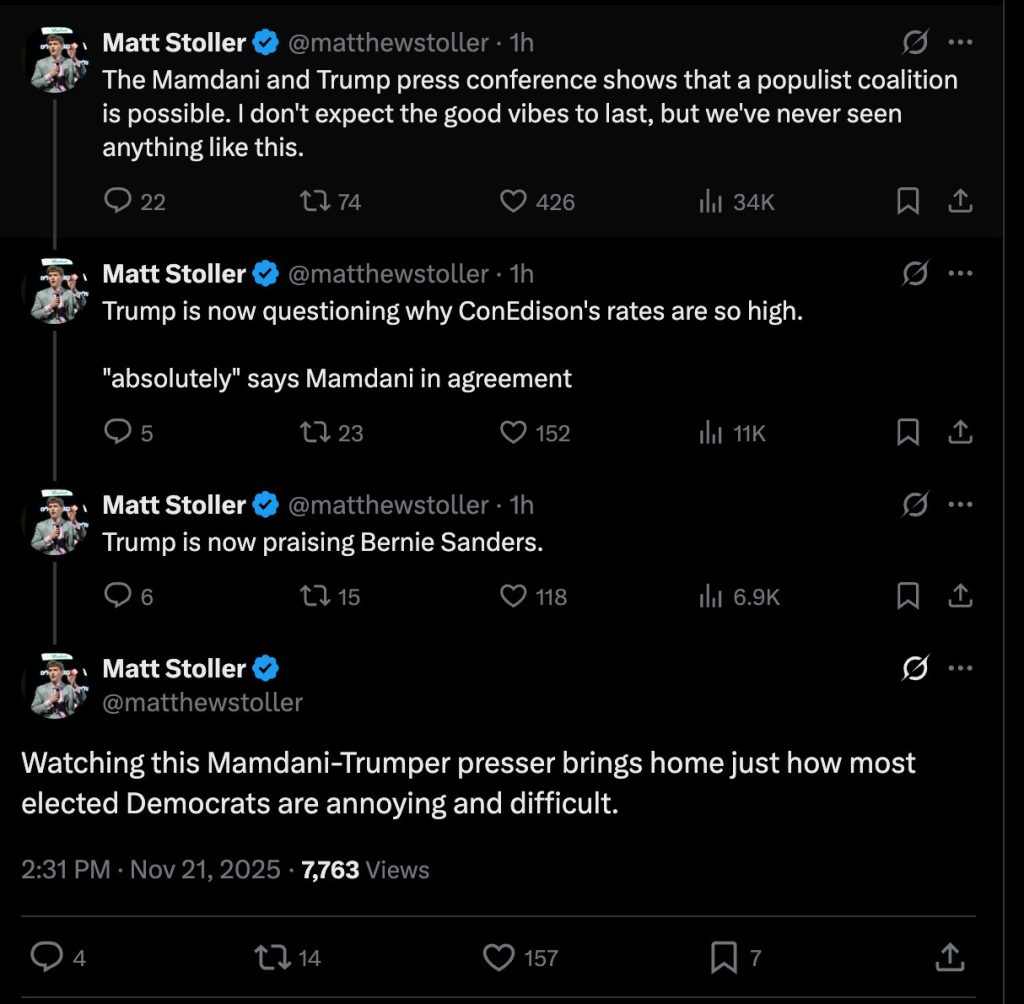
The mere idea that there can be a “bottom vs top” politics should not be allowed in serious discourse. By any reasonable understanding, this is what left vs right is. You see similar ideas to the claims a year ago that Trump 2.0 would be “anti-monopoly”—you didn’t have to wait until one family practically owns every single major media corporation to predict that this would not be true. It’s close too to Cenk Uygur’s casting of Marjorie Taylor Greene as some kind of new politics for voting to release the Epstein Emails and then resigning, ignoring the much more obvious truth that she is saving her own political career from a sinking ship that had no problem putting Epstein’s “closest friend” into the the White House, twice.
I think this strain of notaboutism is powered by a weirder mix of things, that depends a little more on the particular source than the two kinds above. But the ingredients are generally: an intense dislike of the Democratic party as an institution (which can be reasonable or not, depending), a general contrarian streak manifesting as a desire for novel takes, and a negative polarization against the legacy media and its methods of political analysis (which again, can be fair, or pushed past the point of making any sense).
But the main dynamic is still simple: mistaking marketing for substance. Is it true that Trump rails against “elites” far more than George Bush and Mitt Romney did? Sure. Does this mean he won’t turn the entire United States government into a misery and suffering amplifier for everyone who isn’t a billionaire, all so those billionaires can execute the biggest upward redistribution of wealth and resources (aka theft) from the bottom in history? I promise you do not need me to answer this one for you.
To be clear, analyzing how the right brands itself is valuable in aiding our ability to defeat it. In 2016 and, to some extent, 2024, less mainstream political analysts were able to spot the potency of this marketing when legacy institutions could not. But they should not ride so high on their ability to see how the right cobbles together its power as to miss who the boot is always stomping on. On this, Trump & co’s “heterodox” opinions are just the latest new polish.
When encountering this, be especially careful around the word “populist,” which often obscures more than it explains here. Whatever anyone is trying to say with it, in practice, “populism” describes an appearance, not an action. The fact that “right populism” exists proves this, as the right is inherently opposed to empowerment of the masses. The things that populism describes are not political substance, but a way of branding political substance. A way that, when used by the right, is deliberately misleading.
So the next time someone tells you it’s not about right vs left, ask, well, what is it about? Rich vs poor? Elite vs non? Workers vs bosses? Capital vs proletariat? Sure, a cultural association with all the flaws of the existing Democratic Party, or the highly funded media caricatures of democratic socialism may make some suspicious of “the left.” But it’s our job to as clearly and powerfully as possible, redirect that energy towards building actually existing left institutions that do live up to those left wing principles of dignity and equality, and can defeat efforts to mold society around the right wing principles of domination and inequality.
And when we do have to debate how to do so, remember that claiming to be for the little guy while actually selling him out to the big guy is likely the most classic politician lie in history.
Whether pundit, politician or ordinary person, we can all do better than falling for the oldest trick in the book.