
In his immortal podcast Revolutions, Mike Duncan coined the term “The Entropy of Victory” to refer to the historical tendency for post revolutionary groups to fall into disorganization. After attaining a long sought victory, the coalition that brought the revolution about tends to fall apart along new political lines. Some want to consolidate gains. Others want to push forward. Allies become bitter enemies. Former enemies become friends.
While we have not (yet) lived through a revolution, any organizer lucky enough to notch a win under their belt is very familiar with the fact that while winning is exhilarating, it is also chaotic. A group of scrappy fighters finally crests the mountain and looks across a fresh, new landscape of political possibilities and asks themselves, “What now?” They will not all have the same answer.
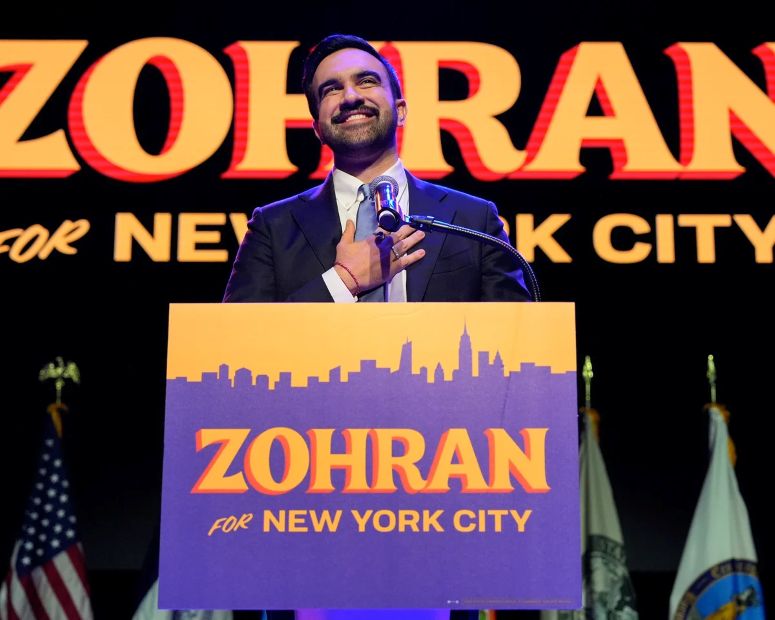
Zohran Mamdani’s victory catapulted the organized socialist left across a new threshold of power. An unapologetic Democratic Socialist will now run the largest city in the country and all but declared war on Donald Trump and oligarchic authoritarianism in his victory speech: “After all, if anyone can show a nation betrayed by Donald Trump how to defeat him, it is the city that gave rise to him. And if there is any way to terrify a despot, it is by dismantling the very conditions that allowed him to accumulate power.” As Trump’s approval ratings fall and the Republicans seem poised to take a historic beating in the upcoming midterms, the socialist left is now on the front foot, a legitimized and powerful force. Our time has finally come.
But in the months since Zohran’s primary victory several fights have broken out inside the socialist movement that demonstrate the entropy of victory. We should not shove these disagreements under the surface. It sucks when those on the left disagree with each other, but ignoring an argument doesn’t make it go away. Instead we should look at who supports what and why, and synthesize new ways forward. This article is an attempt to do so by looking at a question that has underlined many political debates since Zohran’s election: should we consolidate our gains or should we expand? Consolidation would have NYC-DSA focus on winning Zohran’s platform, while expansion would use this moment of political change to expand our movement.
We’ll look at two debates over the potential congressional races of Alexa Avilés and Chi Ossé to better understand how organizers are trying to answer this question.
Like what you’re reading? Support our work by joining our Patreon for free or as a subscriber!
It’s Zohran’s Party Now. Or Is It?
Before we dive in, when we say the organized socialist left, we’re really talking about the Democratic Socialists of America. Since 2016, DSA has been the only game in town for mass socialist organizing, but in the months after Zohran’s victory, DSA has become something that just a year ago would have been a pipe dream: a true political party.That’s a huge deal. All of these disagreements that we will explore involve factions within DSA and while it can be easy to write them off as “DSA drama,” a popular genre of internet discourse, these are all real political conundrums. We have a socialist party now and we have to figure out how to navigate the future.
And complicating all of these fights is Zohran himself. Unlike Alexandria Ocasio-Cortez, who has always put some distance between herself and DSA, Zohran was an elected leader within the organization before running for office and as an assemblymember regularly took part in internal decisionmaking and democracy. As mayor-elect, that hasn’t changed. Zohran has actively encouraged his supporters to join DSA and is still taking part in DSA decision making. That makes total sense! Zohran is a party leader and party leaders can and should take part in the decisions of their party.
But where Zohran has chosen to intervene has caused friction, particularly in the cases of Chi and Alexa, the entropy of victory rearing its ugly head. In both cases, organizers, including Zohran himself, have had to grapple with the electoral opportunities presented in the wake of victory and the political realities of trying to implement a democratic socialist political agenda. These points of disagreement will define the political questions socialists struggle with for the foreseeable future.
Alexa vs. Brad vs. Dan
The first disagreement we’ll look at was around Alexa’s abortive campaign for congress in NY-10, which includes the most progressive parts of Brooklyn. Congressman Dan Goldman, an heir to the Levi Jeans fortune and Zionist moderate, is a terrible fit for the district. He has been a target of the left for years. Alexa Avilés, a NYC-DSA endorsed councilmember, expressed interest in primarying Goldman and received the overwhelming endorsement of the chapter, but then a problem named Brad Lander emerged.
Brad Lander is New York City’s progressive comptroller who was initially viewed as a front runner for mayor, but his happy warrior wonk shtick never really caught on and he found himself eclipsed by Zohran. Lander could have then cozied up to Cuomo in the hopes of landing a plum administration job, but he didn’t. Instead he and Zohran co-endorsed one another and Lander spent the last few weeks of the primary campaign as Zohran’s most fervent supporter.
There was speculation that Zohran would appoint Lander as First Deputy Mayor. But Zohran ended up appointing Dean Fuleihan, a long-time city technocrat. While Lander has always painted himself as an Elizabeth Warrenesque policy dork, he is still a politician with his own career to think of which could have brought him into conflict with the mayor he was appointed to serve. First Deputy Mayor is not the city equivalent of Vice President, a position devoid of power. It is an incredibly important role that will be key to enacting Zohran’s agenda.
Without a mayoral gig, Lander decided to run for Congress in NY-10, which includes his home of Park Slope. While Lander might have lost citywide, he is incredibly popular in NY-10 and the strong favorite to win, effectively cutting off Alexa from the progressive lane. Zohran understood this and expressed as much to Alexa, even saying to her in private that he would support Lander, despite the fact that Alexa was endorsed by NYC-DSA. Lander entered the race with Zohran’s support and Alexa ended up dropping out a few hours later.
This is not just about which candidate to support, there is a political question here. Zohran could have easily appointed Lander First Deputy Mayor—a job Lander very clearly wanted—thus clearing the progressive lane for Alexa. He prioritized his own administration’s success over opening up a potential congressional opportunity for NYC-DSA. Zohran has argued that his successes in office are DSA’s success. Socialists have to show that not only can we govern, but that our governing is superior to that of our capitalist enemies. If Zohran fails, then he risks taking our entire project with him. It’s understandable then why he picked a capable technocrat who helped Bill de Blasio win universal 3k during his first term.
But Zohran’s decision to prioritize the implementation of his own agenda ended up preventing NYC-DSA from running a historic campaign against one of the most powerful Zionists in Congress. What if Lander would have been a perfectly capable deputy mayor and Zohran just removed an opportunity for nothing? Lander is a progressive Zionist, while Alexa is an anti-Zionist. Her victory in NY-10 would have been a national rebuttal of pro-genocide politics.
The end result was a number of DSA members furious with Zohran for endorsing against her. Why couldn’t he have waited until she dropped out? Why couldn’t he have used his influence to at least put pressure on Lander to run as progressive of a campaign as possible, using Alexa’s potential run as leverage? These questions will not derail either Zohran’s administration or NYC-DSA’s political ambitions, but they are nevertheless disorganizing. This is the entropy of victory.
There was a chance for NYC-DSA to expand its political horizons, but Zohran chose to consolidate his wins. Now granted, had Lander entered the race before NYC-DSA endorsed, there’s a good chance members would not have endorsed Alexa. Nevertheless, a political question became a conflict.
Coming for the King
The next point of major disagreement is over another congressional race, this time against arch enemy of the left and House Minority Leader, Hakeem Jeffries. Chi Ossé, a Socialist city councilmember, expressed interest in running against Jeffries, who represents NY-8, which contains progressive and Black neighborhoods in Brooklyn, including NYC-DSA strongholds. It would be a longshot race, but Chi’s supporters argued that a narrow win for Jeffries would nevertheless weaken him considerably. Despite recently joining the organization, Chi promised to work closely with NYC-DSA and many members enthusiastically supported him. But Zohran was worried that Jeffries would interfere with the implementation of his political agenda. Jeffries is the most powerful Democrat in the United States, who only endorsed Zohran a few days before the election. Given that New York State Governor Kathy Hochul has deferred to Jeffries in the past, it wouldn’t be hard for him to pick up the phone and kill Zohran’s agenda, which will need money from the New York State budget.
Those who supported Chi argued that this was a misreading of how politics works. Jeffries and Hochul work for their wealthy donors and will oppose Zohran’s agenda no matter what. The way to win is not to try to placate them, but to attack them. If Jeffries was under threat from a serious primary challenge, he’d have little room to maneuver against Zohran’s agenda for fear of losing his election.
Zohran ended up attending an NYC-DSA electoral forum and speaking out against endorsing Chi. Ultimately, Chi lost the electoral working group’s recommendation 54-46. While Zohran’s opposition did not create a landslide against Chi, it almost certainly tipped the scales. Just like in the Alexa race Zohran chose consolidation over expansion and the consolidators won.
Should I Stay or Should I Grow?
Political questions do not exist in the abstract, they manifest themselves in real-life decisions about strategy. It would be great if we could debate political questions in their platonic form, unfortunately the realities of human existence prevent that. So we can’t help but debate the question of whether we should consolidate or expand within the confines of political conditions.
It feels weird to say, but the socialist movement cannot content itself with running the nation’s largest city. We seek nothing less than complete international transformation of our political and economic systems. This is the core argument for using this moment to expand. We are a movement that is bigger than New York City, that is bigger than the United States of America. To fail to use this moment of unprecedented momentum to build our project, would be a devastating missed opportunity. Finally, expansionism can help achieve Zohran’s agenda. By aggressively going after powerful opponents, we can keep them on the backfoot to prevent them from messing with Zohran’s agenda.
But if Zohran is not able to freeze rent, to lower costs for working families, or deliver on community safety, then our entire project will be delegitimized. Can Zohran afford to risk his mayoralty by appointing Brad Lander to the second most powerful role in the city or by making an enemy of the most powerful Democrat in the country? Consolidation and the transformation of New York City is a worthy goal in it of itself and will allow the socialist movement to grow sustainably over the next few years. And while continuing to take on big fights could help Zohran win his agenda, reckless fights will have the opposite effect.
It’s easy to see how just small changes in the political winds could drastically alter our analysis for various situations. What if Jeffries is unable to carry the banner of opposition (a decently likely proposition) and like Chuck Schumer, sees his favorability plummet? Then a primary challenge would have been the right decision. What if Zohran meets more than expected resistance and will need to rely on powerful outside movements to support him? Then maybe running two difficult congressional races would have taken away resources from him. What if Brad Lander’s campaign for congress tanks like his mayoral campaign? (On day one of his campaign his X account was hacked by crypto scammers.) Maybe Alexa should have stayed in the race.
Putting Up Guardrails
It’s impossible to say whether either side of the consolidation or expansion debate is correct or not. Even if you find yourself stridently in one camp, it is easy to see that the other is operating in completely good faith. And to complicate things even further, there are very few pure Expansionists and Consolidators. Instead these two poles represent political outlooks that can be applied to any political decision, not identities. They are approaches to understanding the contradictions of power. There were some organizers who supported endorsing Alexa, but opposed endorsing Chi and vice versa! Political questions are never abstract and the conditions that inform upon them are crucial.
But there are some things we can do to narrow the framework of the debate so that the political questions become starker and easier to dissect. Think of them as political guardrails that keep us from veering off the strategic path to victory.
The first guardrail is for the Expansionists. Zohran’s victory does not mean that the usual laws of political gravity do not apply. Just because Zohran won does not mean that the organized left can win any election. It does not mean that third parties are suddenly viable. It does not mean that we should endorse anyone who shows up at a meeting and declares themselves a Socialist running for higher office.
In fact, Zohran won because of the rules of politics not in spite of them. While yes, Zohran was originally polling at 1%, Cuomo’s unfavorability was astronomically high. It was always clear that Cuomo was beatable, it was just an open question of who would beat him. Furthermore, Zohran benefited from the public reaction against Trump’s narrow victory. The lesson from Zohran is not that we live in a new world where they do not apply anymore and we can win anything, but that we are in a moment when the underlying political conditions favor a well-run Democratic Socialist campaign.
So that limits the Expansionists. We can’t expand wherever and whenever we want. We still have to be ruthlessly strategic about electoral politics.
As for the Consolidators, if we decide to focus on implementing Zohran’s platform, it’s important that we do so because implementing his platform is crucial for the international socialist movement. We cannot build socialism in one city. Yes, the political moment requires Zohran to be successful, but our movement is so much bigger than Zohran, so much bigger than any one person. Implementing Zohran’s platform needs to build socialism, whether it is by politicizing and organizing thousands of New Yorkers to fight for it and/or cohering segments of the working class and giving them power. If he just wins policies without building the socialist movement, Zohran will be a better version of Bill de Blasio, nothing more.
And we don’t have much time. 2028 is coming a lot sooner than any of us expect. The United Auto Workers is already planning for a general strike and as soon as the 2026 midterms are over, jockeying for the 2028 presidential campaign will begin. 2028 will be one of the most important moments in American history, when the broken and damaged authoritarianism of Trump comes head to head with a rising and radicalized democratic movement. If a Democratic presidential candidate wins, thermostatic public opinion will swing back towards the right. Without a powerful left putting overwhelming pressure on the president, we could end up with another milquetoast liberal like Biden and find ourselves in a moment of fascist resurgence. If we need to focus on New York City now, that is understandable, but that cannot be the limit to our horizons.
We cannot escape the contradictions of power. Overthrowing capitalism by definition requires it. We are lucky to be struggling with such weighty questions, but that doesn’t mean that struggling isn’t difficult. We have learned how to win, now we have to learn how to figure out what comes next.